Henry Tavener
All Creatures Great and SmallHenry Tavener is a prosperous former shipyard magnate whose warmth and evident tenderness toward his dog are set against the coldness of his wife and daughter. During James Herriot’s visit to treat the dog, Tavener emerges as both a generous host and a vulnerable man: a pronounced tremor interrupts his hospitality, and the family’s departure leaves him sitting alone in the drive’s fading exhaust smoke.
Identity and Background
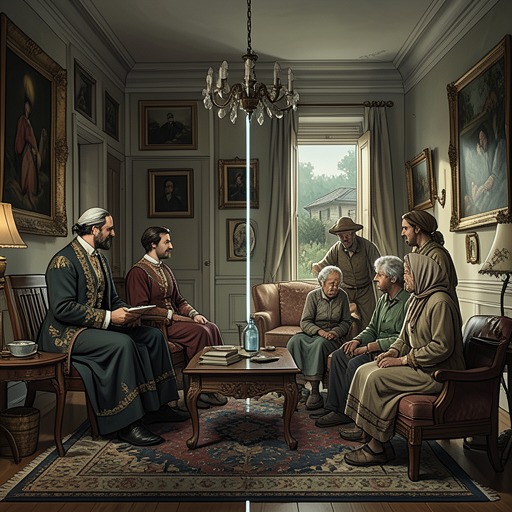
In his fifties, Tavener had made millions in the Tyneside shipyards before leaving the industrial smoke for a beautiful house with terraced gardens descending toward a river. The house and its contents register his wealth without reducing him to it. Its walls hold original paintings by famous artists, and its elegant period furniture is interspersed with rare clocks. The paintings have become the main interest of his life; clocks are another passion. These objects suggest a cultivated domestic world, but the scene’s emotional center is not the collection. It is Tavener’s concern for the sick dog and his willingness to welcome the veterinarian who has treated it.
Herriot had expected a tough tycoon and instead found a warm, friendly, curiously vulnerable man, obviously worried sick about his dog. That contrast is important to Tavener’s characterization: the fortune and the former industrial career establish his public stature, while the visit exposes a gentler, more exposed quality. His attachment appears in practical gestures as well as worry. He holds the dog for treatment, thanks Herriot for relieving their minds, and offers him a drink before he leaves.
The Dog and the Household
The terrier’s sudden pain gives Tavener’s anxiety a concrete cause. After Herriot injects the dog and provides salicylate tablets, he tells Tavener to give one once the injection has eased the animal and to repeat it about four hours later. Tavener’s concern is not abstract: he had thought the old dog’s time had come when it began yelling, and he is relieved to hear that it should improve. Once treatment is finished, he invites Herriot to stay for a drink, turning a veterinary call into an act of hospitality.
That tenderness is set against the family’s conduct during the same visit. Mrs. Tavener repeatedly criticizes her husband while he holds the dog, blaming him for letting it swim in the river. When Julia arrives, she joins her mother’s rebukes. Mrs. Tavener takes the medicine box from her husband as he begins reading the directions, insisting that she will be the one to administer them. The scene shows Tavener responsible for holding the animal and deeply concerned about its pain, yet treated as though he cannot be trusted with its care. The dog draws his affection and worry into view; the family’s accusations make that concern a reason to attack him.
The Tremor and the Visit
Tavener’s hand trembles as he takes Herriot by the arm and again when he pours whisky. The shaking becomes so pronounced that he spills the drink on the polished sideboard. Herriot considers several possible explanations, including Parkinson’s disease, nerves, or drink, but the scene supplies no diagnosis. What it does establish is that the tremor is visible in ordinary actions and that the household recognizes it as a recurring source of distress.
Mrs. Tavener responds with an anguished outburst, while Julia strikes her forehead and raises her eyes to heaven. Their reaction frames the spill not as a small accident but as another unwelcome episode. Tavener gives the women a single hunted look, then grins as he hands Herriot his glass. He continues to behave pleasantly, talking about dogs, the countryside, and the pictures in the room. His hospitality persists even as the tremor and the family’s response expose how precarious his composure is.
Isolation and Narrative Significance
After disappearing while the men drink, Mrs. Tavener and Julia return in expensive tweed coats and fur-trimmed hats, ready to drive to Brawton. Mrs. Tavener says they do not know when they will be back; Julia looks coldly at her father. Tavener does not reply. He sits motionless while the car engine roars and gravel spatters outside, then watches the exhaust smoke drift across the drive with a blank, empty expression.
The contrast between the earlier generous host and this silent figure makes the departure the visit’s decisive turn. Herriot senses something chilling in Tavener’s expression and gets up to leave. Tavener seems to recover his awareness of the visitor, returns to a friendly smile, and thanks him for caring for the dog, which already seems better. In Herriot’s rear-view mirror, Tavener remains at the top of the steps, growing small and alone until the high shrubbery hides him. That final image does not explain the family’s history or the cause of the tremor; it concentrates what the encounter has shown. Tavener’s wealth fills the house with paintings, clocks, and elegant furniture, but it cannot make this moment of abandonment less stark. His care for the dog and his courtesy toward Herriot remain visible, even as the household leaves him isolated in his own home.